
Preschool Counting Milestones Parents Can Trust

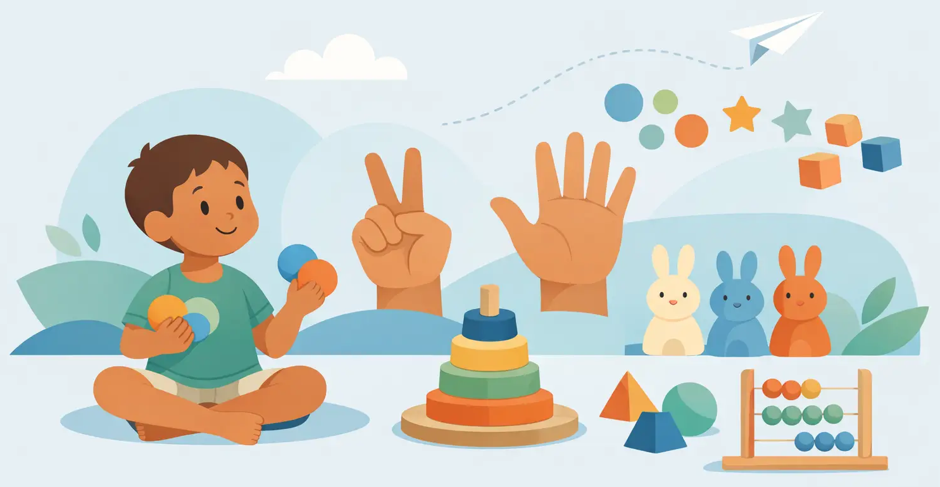
A child proudly racing through “one, two, three... ten!” at breakfast may look ready for mathematics. But preschool counting milestones involve much more than reciting number words in order. Real number sense grows when children begin connecting each spoken number to an object, recognising that the final number tells them “how many” and using numbers confidently in everyday situations.
For parents, these early years are a wonderful opportunity to nurture curiosity without turning every moment into a test. A playful, structured approach can help a child build the attention, visual skills, working memory and confidence that support later arithmetic. The goal is not to rush ahead. It is to help each child understand numbers deeply enough to enjoy using them.
What Preschool Counting Milestones Really Measure
Counting develops in layers. A preschooler may say numbers to 20 before they can accurately count five buttons. This is common. Number recitation is a useful first step, but it is different from understanding quantity.
When educators consider counting development, they often look at several related skills: saying number words in sequence, matching one number word to one object, knowing that the last number counted represents the total, recognising small groups without counting and comparing which group has more or fewer objects. Children do not always develop these skills at the same pace.
A child who loves songs may learn the number sequence quickly. Another child may be quieter but show strong understanding by sharing snacks fairly between family members. Both are making progress. What matters most is steady growth, not a race with other children.
Preschool Counting Milestones by Age
Age ranges are helpful reference points, not deadlines. Children develop at different rates depending on their experiences, language development, attention span and comfort with new challenges. Look for patterns over time rather than expecting perfect performance every day.
Around Age 3: Numbers Become Part of Play
Many three-year-olds can begin reciting a short string of number words, often from one to five or beyond. They may count a few objects, although they may skip objects, count the same item twice, or continue counting after the objects run out. These are normal signs that a child is learning how counting works.
At this stage, keep quantities small and visible. Ask, “Can you give me three blocks?” Then touch each block together while saying one number for each. Movement is especially helpful. Children can clap three times, take four giant steps or place two strawberries on a plate.
They may also start recognising very small quantities instantly. Seeing two eyes on a toy or three dots on a die without needing to count is an early visual-number skill called subitising. It helps children form mental pictures of quantity, which later supports faster calculation.
Around Age 4: Counting Has a Purpose
By four, many children can count objects more accurately to five or 10 and are beginning to understand one-to-one correspondence. In simple terms, they learn that each object needs one count and each count belongs to one object.
They may answer “How many?” after counting a small group, though they may need a reminder that the final number is the answer. This is known as cardinality, and it is one of the biggest shifts in early mathematics. A child is no longer only repeating a number rhyme. They are using numbers to describe a real quantity.
Four-year-olds may also notice simple comparisons. A child might say that a row of six toy cars has more than a row of three, or that two groups are the same when each has four pieces. Encourage the language of more, fewer, same, bigger and smaller. These words make early number relationships easier to understand.
Around Age 5: From Counting to Early Operations
Many kindergarten-age children can count reliably to 10 and often beyond, count a set of objects to 20 with growing accuracy and recognise familiar numerals. They may begin matching the written numeral 7 to a group of seven counters.
This is also when children can explore the first ideas behind addition and subtraction. If there are three apples and two more are added, they may count all five. If one is taken away, they may count what remains. They do not need formal worksheets to learn this. Small, meaningful problems are more powerful: “We have five crackers. If dad eats one, how many are left?”
Some children will start counting on from a larger number, such as saying “six, seven, eight” when three are added to five. Others will still count every item from one. Both approaches are appropriate. Counting on usually appears after a child has had plenty of experience with small groups and quantities.
What Matters More Than the Highest Number They Can Say
Parents sometimes hear a young child count to 50 or 100 and assume this means the child has mastered early mathematics. It can be an encouraging sign of memory and interest, but it is only one part of the picture.
A stronger indicator is whether a child can use numbers meaningfully. Can they count out six spoons for the table? Can they tell whether four cookies are more than two? Can they explain that five can be made from three and two? Can they spot and correct a counting mistake when an object was counted twice?
These experiences build flexible thinking. Instead of memorising isolated facts, children learn that numbers represent quantities, can be compared and can be combined or separated. This understanding prepares them for the four core operations later on: addition, subtraction, multiplication and division.
Simple Ways to Build Counting Confidence at Home
The best counting practice often happens during ordinary family routines. It should feel active, warm and achievable. Start with a quantity your child can handle successfully, then add a little challenge when they are ready.
At mealtimes, invite your child to count plates, chopsticks, cups or pieces of fruit. During a walk, count steps to the lift, buses passing by or red cars at the traffic light. While tidying up, ask them to put five toys in a basket or sort blocks by colour before counting each group.
Songs, rhythm and movement can make number sequences easier to remember. Try clapping as you count, tapping out simple patterns or using fingers to show a number as you say it. Children learn through their senses, so seeing, touching, hearing and moving with numbers can strengthen recall.
A simple abacus can also give young learners a clear visual and tactile way to explore quantity. Rather than seeing numbers as abstract symbols, they can move beads, observe groups and build a mental image of number relationships. With patient guidance, this kind of hands-on practice can support focus, visual learning, speed and accuracy without taking the joy out of discovery.
When a Child Needs More Support
An occasional mistake is not a concern. Preschoolers are easily distracted, tired or more interested in playing than answering a question. It is also normal for a child to perform a skill one day and seem to forget it the next. Learning is rarely a straight line.
It may be helpful to offer extra practice if a child consistently avoids number activities, cannot yet match one object to one count after repeated playful experiences or becomes unusually frustrated by small quantities. Begin by reducing the challenge. Count two or three favourite objects, use physical movement and praise effort rather than speed.
If concerns extend beyond counting, such as significant difficulty with language, attention or understanding simple instructions, speak with your child’s preschool teacher or paediatric professional. Early support works best when it is encouraging and specific, never when it is shame-based.
Turning Readiness into a Love of Learning
A child does not need to be pressured to become capable. They need repeated moments of success, clear instruction and adults who show that numbers are useful and fun. Celebrate the effort behind the answer: “You touched each bear carefully while you counted” or “You noticed there were more blue blocks. That was thoughtful.”
As children become more secure with counting, they are ready for richer challenges that connect visual quantity, number symbols and mental calculation. Structured programmes such as Mentalmatics can build on this readiness through engaging activities, abacus learning, music and progressive practice designed to nurture little geniuses.
Keep numbers close to your child’s everyday life. A counted stairway, a shared snack or a row of beads can become a small victory – and small victories are where confident mathematicians begin.
How Mentalmatics Can Help
At Mentalmatics, the counting foundations this article describes are precisely where the programme begins. From age three, children are guided through structured abacus activities that make quantity visible and tangible – building one-to-one correspondence, cardinality and early number sense through songs, movement and hands-on bead work. Each milestone is met at the child's own pace, with trained instructors ensuring that understanding is secured before the next stage is introduced. The result is a preschooler who does not merely recite numbers, but genuinely understands what they mean, and confident and ready for what comes next.
To find out more, talk to us or register for a trial class using the link below!


Comments