
How to Reduce Maths Test Anxiety in Children

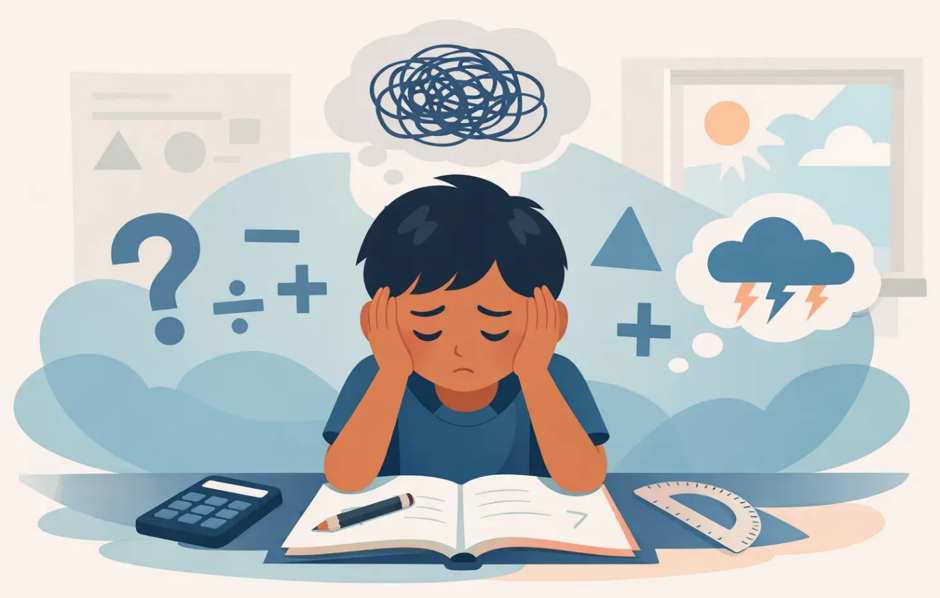
A child who knows how to solve a maths question at home may suddenly freeze when a test paper lands on the desk. They may rush through familiar questions, leave answers blank or say, “I’m just bad at maths.” To reduce maths test anxiety, children need more than reminders to stay calm. They need steady skills, predictable routines and proof from their own experience that they can work through a challenge.
For parents, the goal is not to remove every feeling of nervousness. A little anticipation can help a child pay attention. The concern begins when fear blocks recall, causes careless mistakes or makes mathematics feel like something to avoid. With patient preparation, maths can become a space where children feel capable, focused and proud of their progress.
Why Maths Tests Can Feel So Overwhelming
Maths is often taught as a subject with clear right and wrong answers. For some children, that certainty feels satisfying. For others, one incorrect answer can feel like evidence that they have failed. This is especially common in primary school, when timed work, word problems and more complex operations begin to appear more often.
Test anxiety can also come from gaps that are easy to miss. A child may understand addition but still count slowly. They may know multiplication facts one day but struggle to retrieve them under time pressure. When their basic number sense is not yet automatic, every question takes more effort. Their working memory becomes crowded, and anxiety has more room to take over.
Parents should also consider the messages surrounding a test. Comments such as “You must get full marks” or “This is easy, why can’t you do it?” are usually meant to motivate, but they can make a child feel watched and judged. Children respond better when effort, strategy and improvement receive attention alongside scores.
Reduce Maths Test Anxiety by Building Real Readiness
Confidence is strongest when it has evidence behind it. Rather than relying on last-minute drilling, help your child build familiarity with numbers over time. Short, regular practice sessions are usually more effective than a long, tiring session the night before a test.
Start with the skills that make current schoolwork feel easier. This may mean number bonds, place value, addition and subtraction facts, multiplication tables or division patterns. When these foundations become more automatic, children can give their attention to the question itself instead of using all their energy on basic calculation.
Mental arithmetic practice can be particularly helpful because it encourages children to see relationships between numbers. For example, a child who recognises that 48 + 19 can become 48 + 20 - 1 has a useful strategy ready when the test clock is running. Abacus learning can support this development too. As children move from physical beads to mental visualisation, they practise concentration, accuracy and flexible number thinking in a clear, progressive way.
The right level of challenge matters. Work that is far too easy does not prepare a child for an assessment, while work that is consistently too difficult can reinforce worry. Aim for practice where your child can complete most questions independently, with a few that require coaching and thought.
Practise the Test Situation Gently
A test should not be the first time a child experiences a time limit, a quiet desk or a mixed set of questions. Once your child understands the topic, try a short practice paper under test-like conditions. Keep it brief at first – perhaps 10 minutes for younger learners – and increase the time gradually as their confidence grows.
Subsequently, do not begin with the total score. Ask what felt easy, where they paused and which strategy helped. Review mistakes calmly. A wrong answer may show a calculation slip, a misunderstood instruction or a skill that needs more practice. Each reason calls for a different response, and none of them require shame.
It also helps to teach a simple routine for difficult questions: read carefully, underline key information if allowed, solve one step at a time, then check. A child who has a plan is less likely to panic when a question looks unfamiliar.
Create a Calmer Routine Before Test Day
The evening before a maths test is not the moment for a major learning sprint. If a child is exhausted or overwhelmed, extra worksheets may create more stress than progress. A brief review of familiar examples is enough. Then protect sleep, prepare school materials and allow the mind to rest.
On the morning of the test, keep the atmosphere steady. A balanced breakfast, enough time to get ready and a warm send-off can make a real difference. Instead of saying, “Don’t make careless mistakes,” try, “Take your time, use the methods you practised and show what you know.” This gives children an action they can take.
Some children benefit from a small physical reset before they begin. They can place both feet on the floor, relax their shoulders and take three slow and deep breaths. For younger children, it may help to describe this as “settling the body so the brain can think”. These strategies will not replace preparation, but they can help a prepared child access what they already know.
Help Children Talk Back to Unhelpful Thoughts
An anxious child may think, “I will fail”, “Everyone else is faster” or “I can’t do division”. These thoughts feel true in the moment, but they are not useful instructions. Parents can help children replace them with language that is honest and encouraging.
“I can’t do this” can become “I can do the first step”. “I always get these wrong” can become “I am still practising this type of question”. “I have to finish first” can become “I need to read and work carefully”. The aim is not forced positivity. It is helping children focus on what they can control.
Be careful not to compare siblings, classmates or past test scores too often. Children develop at different speeds, especially when they are learning foundational skills. Celebrate meaningful gains: fewer counting errors, neater working, faster recall, better checking or the willingness to attempt a challenging problem. These small wins build the belief that ability grows through practice.
When Anxiety Signals a Bigger Need
Occasional nerves are normal. However, extra support may be needed if your child frequently cries before tests, complains of headaches or stomachaches, refuses to attend school or becomes highly distressed by ordinary maths homework. Speak with the child’s teacher to understand whether the challenge is mainly emotional, academic or both.
Sometimes the best next step is targeted instruction that rebuilds skills in a supportive setting. A structured program can give children repeated success with the four operations, number patterns, mental calculation and problem-sums. When learning feels engaging through visual activities, games, music and guided practice, children often begin to see mathematics as a skill they can develop rather than a verdict on their intelligence.
At Mentalmatics, this confidence-building approach begins with concrete number understanding and progresses toward faster, more accurate mental work. The important point is not speed for its own sake. Speed becomes valuable when it rests on understanding, accuracy and a child’s growing trust in their own thinking.
Give Praise That Builds Courage
After the test, welcome your child before asking about marks. A simple “I’m glad you’re home” tells them that their relationship with you is bigger than one paper. When they are ready to talk, ask what they were proud of, what felt challenging and what they might practise differently next time.
Children do not need perfect test days to become strong maths learners. They need many chances to prepare, try, recover from mistakes and recognise that each solved problem is evidence of growth. With calm support at home and skills that become more secure over time, a test can gradually feel less like a threat and more like one moment to show what they are learning.
How Mentalmatics Can Help
At Mentalmatics, maths anxiety is addressed at its root by building the automatic number sense, calculation accuracy and mental flexibility that children need before a test begins. Through structured abacus and mental arithmetic training, children develop the working memory and fluency that free up cognitive space under pressure, so that anxiety has less room to take hold. Regular, progressive practice in a warm, encouraging environment replaces last-minute cramming with genuine readiness, giving children quiet confidence drawn from experience, in addition to reassurance.
To find out more, talk to us or register for a trial class using the link below!



Comments