
How to Choose a Maths Tutor When Your Child Needs Extra Help

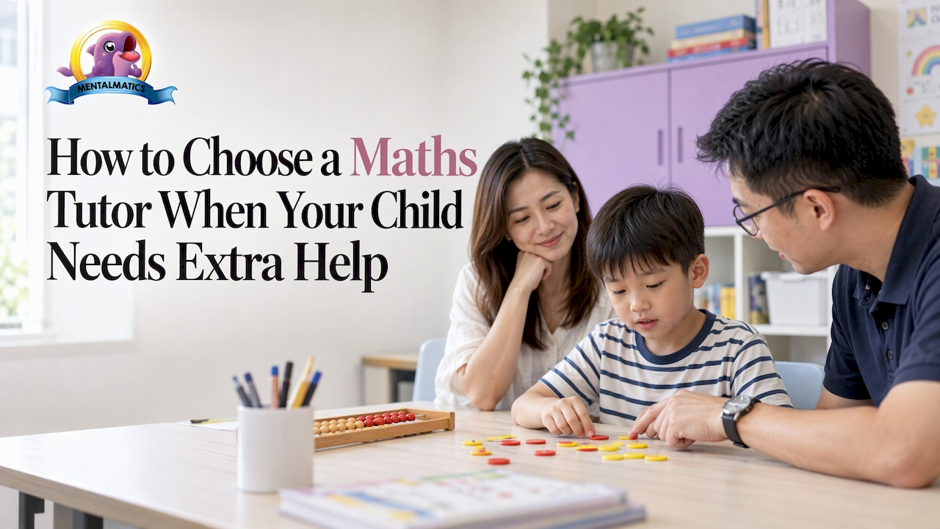
If your child is avoiding maths, losing confidence or slipping behind the pace of the class, a maths tutor can help, and the best time to find one is when the first signs appear rather than when exam results arrive. The right tutor looks at where your child's understanding has gaps, explains concepts in a way that suits your child's age and temperament, and keeps practice patient and encouraging. This guide shows you how to spot the signs, what to do first, and how to choose a tutor with confidence.
Signs Your Child May Need Maths Support
Every child finds some topics harder than others, so one poor test does not mean something is wrong. What matters is the pattern over several weeks. Look for these everyday signals:
Counting on fingers long after it should be needed. A Primary 1 child who still counts one by one for simple sums may not yet have a secure sense of numbers.
Mixing up place value. Reading 204 as "two hundred and forty" is a classic example.
Avoiding word problems. Some children freeze, ask for the question to be read aloud again and again, or leave the page blank.
Careless errors that keep repeating. These can point to a concept that was never fully understood, not simply a lack of attention.
Homework taking far longer than it should, or ending in tears.
Comments such as "I'm just bad at maths". A change in attitude often shows up before a change in marks.
Older primary pupils show different signs. In Primary 3 and 4, you may see a child struggling with multi-step problem sums or treating decimals as if they were whole numbers. We have also put together a longer checklist in 8 signs a child needs maths support at school, which you can read alongside this guide.
If your child is still in kindergarten, the signs are softer: little interest in counting games, difficulty matching a number to a group of objects, or reluctance to try. At this age the goal is not to push, but to build comfort with numbers early. Our guide on how to prepare your kindergarten child for maths offers gentle ways to start.
Start With a Conversation, Then Decide on a Tutor
Before you choose anyone, find out what your child's teacher sees in class. A short chat about which topics your child finds difficult, and whether the difficulty is with concepts, speed or confidence, gives you something concrete to bring to a tutor.
It also helps to know that Singapore schools have their own support. According to the Ministry of Education, pupils who need additional help in mathematics are identified at the start of Primary 1 for the Learning Support for Mathematics programme, and more pupils may be identified later in Primary 2, 3 or 4. The programme is run by trained teachers in small groups and focuses on building numeracy skills.
School support and a tutor can work side by side. In school, your child gets group instruction guided by the national syllabus. A tutor, whether in a small class or one-to-one, can give your child more time to practise, more chances to ask questions without feeling watched, and a pace that adapts to your child. Many parents find that this combination restores confidence faster than either on its own.
What a Good Maths Tutor Actually Does
When you compare tutors, look past the promises and focus on how they teach. A good tutor should:
Diagnose before teaching. They look at recent test papers and homework to spot patterns in your child's mistakes, and may set a short, focused assessment.
Explain the "why". Memorising steps works only until the question changes. Look for a tutor who builds understanding so your child can handle unfamiliar problems.
Ask guiding questions. Instead of giving the answer, the tutor asks your child to explain their thinking and uses questions to lead them to correct a mistake.
Share a clear plan. You should know which gaps are being filled, in what order, and how this connects to what the school is teaching.
Stay patient with problem sums. Word problems are where many children lose heart, so warmth and a calm manner matter as much as subject knowledge.
Keep your child engaged. A child who dreads the lesson will not learn well, however qualified the tutor.
This fits with how Singapore's own syllabus describes good teaching. The MOE Primary Mathematics Syllabus names activity-based learning, inquiry-based learning and direct instruction as the three approaches that make up mathematics teaching, with teachers choosing between them according to the learner and the concept. A tutor who can move between hands-on activity, questioning and clear explanation is working in the same spirit.
Matching the Tutor to Your Child's Age and Temperament
The best format depends on the child. Here is a practical way to think about it.
Preschool and Kindergarten (Ages 4 to 6)
Young children learn numbers through touch, movement and play. At this stage you are looking for lessons that feel like games, not worksheets. Songs, counting activities and physical materials help children understand quantity before they meet written symbols. This matches the approach the Ministry of Education takes in its early learning resources, which suggest that manipulatives such as multi-link cubes, pattern blocks and counters help children grasp numeracy concepts, and that board games, dominoes and matching card games can reinforce those skills.

Lower Primary (Primary 1 and 2)
This is the stage where foundations are set: number bonds, place value and the four operations. A child who is slightly unsure here can find subsequent topics increasingly confusing, so early support pays off. Look for a tutor who builds number sense and gives short, regular practice. Our parent's guide to Primary 2 maths tuition walks through what to expect at this level.
Middle Primary (Primary 3 and 4)
Multi-step problem sums, fractions and decimals arrive, and the language of questions becomes more demanding. Children who know the procedures can still stumble if they misread what is being asked. A tutor at this level should teach your child how to break a problem into parts, draw a model and check the answer.
Upper Primary (Primary 5 and 6)
With the PSLE approaching, your child needs fluency, accuracy and stamina. Targeted practice on weak topics, along with a calm approach to exam technique, makes the biggest difference.
Temperament
A shy child may blossom in a small group where classmates are learning alongside them. A child who feels embarrassed about making mistakes may prefer one-to-one attention. An energetic child often responds to lessons with movement and games. Think about whether your child learns best by listening, watching or doing, and choose accordingly.
Our Perspective: Build the Thinking, Not Just the Marks
We meet many parents who come to us after a disappointing test, worried that their child “cannot do maths”. In our experience, what looks like a lack of ability is often a lack of confidence, and confidence grows when numbers feel manageable and even enjoyable.
That is why we teach through a two-hand, four-finger abacus technique that moves children step by step from the physical abacus to mental arithmetic. Children first see and feel numbers, then picture the abacus in their minds, and finally calculate without any tool. We designed the technique to engage both sides of the brain, so that logical and creative thinking develop together.
We also believe a child learns best when they are not afraid. Our lessons include songs, games and physical activities, and children can progress at their own pace, including through our online portal. A child who meets numbers with curiosity is far more willing to keep trying when a problem gets harder.
For parents, our advice is simple: do not wait until your child has lost heart. Starting early, in a playful way, and practising a little each day builds the number sense that school maths relies on.
What Mentalmatics Offers
We offer programmes for children from pre-primary to primary level, so you can choose the one that fits your child's stage. Kindy Class introduces younger children to numbers through play, Foundation builds core skills with the abacus, and Intermediate & Advanced Class takes mental arithmetic further. If your child needs support with school topics directly, our Maths tuition focuses on the four operations and problem-solving.

Not sure which one suits your child? A trial class lets you and your child see how a lesson feels before you decide. If you would like to understand how the abacus connects to school maths, read how abacus and mental arithmetic support your child's primary school maths journey.
Support Your Child's Learning at Home
A tutor works best when home practice reinforces what is taught. The good news is that it does not need to be long or formal. Five to ten minutes a day of oral practice is often enough for younger children, such as quick number bonds in the car or on the way to school.
For preschoolers, the National Institute of Early Childhood Development suggests everyday activities, including sorting and matching, comparing quantities at mealtimes and counting as part of the day. One simple idea is to ask a child playing with blocks to build a tower of ten, which helps them count to ten, match one number to each block and understand that the last number counted tells you how many there are.
For primary school children, try:
Shop play. Use real coins and notes so your child can add up costs and work out change.
Going through corrections together. Ask your child to explain where the mistake happened, rather than simply showing the right answer.
Short mental arithmetic games. Make them quick and light, and stop while your child still wants more.
Praise for effort. Notice when your child keeps trying, not only when the answer is right.
You will find more ideas in 7 ways to make maths practice fun at home, and in our article on strategies to foster a positive attitude towards maths. Attitude matters. A child who believes they can improve will usually put in the practice that makes it happen.
When to Look Beyond a Tutor
Some children struggle in a way that goes beyond a few weak topics. If your child has persistent difficulty understanding number concepts, cannot recall basic maths facts despite plenty of practice, or has trouble with spatial reasoning, it is worth looking more closely. SHINE Children and Youth Services lists these among the early indicators of maths difficulties such as dyscalculia, and recommends speaking to your child's teacher and consulting a healthcare professional. It also points to children and youth organisations that offer psycho-educational assessments and intervention programmes.
If you have these concerns, speak to your child's school teacher or form teacher first, and ask your paediatrician or a psychologist about an assessment. Having the right information helps you and any tutor you choose to support your child in the right way. A patient tutor can still be a valuable part of the picture, as long as the lessons move at your child's pace.
Questions to Ask Before You Enrol
Take this list when you speak to any tutoring centre or tutor:
How will you find out where my child's gaps are?
How do you explain a concept when a child does not understand the first time?
Do the children explain their own thinking in lessons?
How will I know how my child is progressing, and how often will you update me?
How does the lesson connect with what the school is teaching?
How do you keep younger children interested and moving?
What does home practice look like, and how long should it take?
Can my child try a lesson first?
The last question matters most. Your child's reaction after a lesson tells you a great deal about whether the fit is right. A child who comes out curious and a little proud is on the right track.
Setting Realistic Expectations
Maths tutoring is not a quick fix, and no responsible tutor will promise a fixed grade. What you can reasonably expect is progress in stages. First, your child relaxes and begins to ask questions. Next, accuracy improves on the topics that were weak. Finally, confidence carries over into the classroom and into new topics.

Weak maths results can have many causes: concepts not fully understood, misreading the question, a limited grasp of the keywords used in problem sums, or simple carelessness. Good tuition looks at which of these applies and works on that specific cause. This is why a tutor who takes time to understand your child at the start will usually serve you better than one who hands out extra worksheets.
For most families, a sensible approach is to commit to a term, watch for changes in attitude as well as marks, and review. If you would like to see how maths enrichment fits in, our article on maths enrichment classes for primary students explains the options, and our Tips page collects more practical advice for parents.
Frequently Asked Questions
At what age should I start looking for a maths tutor?
There is no fixed age. Start when you notice signs such as avoiding maths, repeated mistakes or falling confidence. For younger children, playful early classes can build number sense before school maths becomes demanding, which many parents find reassuring.
Should I choose one-to-one tuition or a small group?
It depends on your child. A child who is shy or worried about mistakes may like one-to-one attention, while a child who enjoys company often learns well in a small group. Think about how your child learns best, then ask for a trial lesson to see how they respond.
How do I know if the tutor is helping?
Look beyond test scores. Signs of progress include your child explaining their working, attempting word problems without prompting, finishing homework more calmly and speaking about maths more positively. Ask the tutor for regular updates on which topics are improving.
Can a tutor help if my child's difficulty may be a learning difficulty?
A supportive tutor can help your child practise at a comfortable pace, but a learning difficulty such as dyscalculia needs a proper assessment. Speak to your child's teacher and a healthcare professional first, then share their recommendations with the tutor so that lessons fit your child's needs.
Is the abacus useful for a child who is struggling with school maths?
Our programmes use the abacus to help children see and feel numbers before they calculate mentally, which supports number sense and speed with the four operations. You can book a trial class to see how your child responds.
Recommended
How Mentalmatics Can Help
At Mentalmatics, the qualities this guide recommends in a tutor are built into the teaching: patient, encouraging and focused on understanding, not just marks. Children move step by step from the physical abacus to mental arithmetic through a two-hand, four-finger technique, building number sense, concentration and confidence. Songs, games and physical activities keep lessons light, and children progress at their own pace, including through the online portal. Programmes from Kindy to the upper levels suit each stage and temperament, and the approach complements school maths.
To find out more, talk to us or register for a trial class using the link below!


Comments