
The Two Pillars of Primary Education: Why English and Mathematics Matter Most

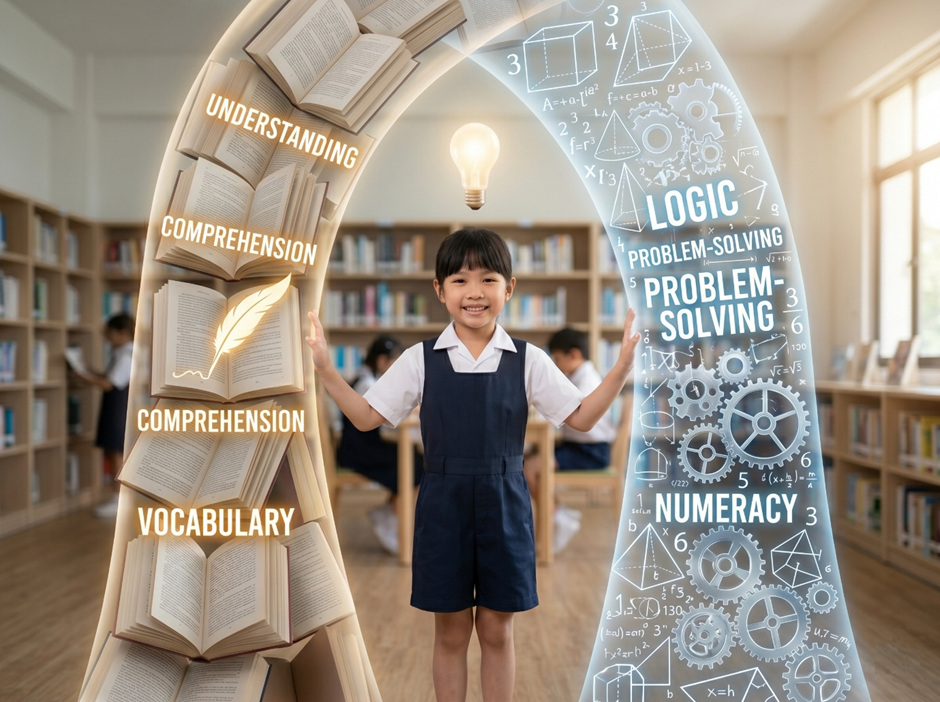
In Singapore's well-structured and highly competitive education landscape, primary school is widely regarded as the foundation upon which a child's entire academic journey is built. Across the six years of primary education, students are exposed to English, Mathematics, Mother Tongue and Science, with each subject carrying its own weight and purpose. Among these, two subjects stand out as the undisputed cornerstones of a child's learning: English and Mathematics.
This is not to diminish the value of Mother Tongue or Science. Both are important in their own right, with Mother Tongue preserving cultural identity and bilingual fluency while Science cultivating curiosity and an understanding of the natural world. Regardless, English and Mathematics occupy a unique and irreplaceable position in a child's academic development. They are not merely subjects on a timetable. In fact, they are the very tools through which all other learning becomes possible.
English: The Language of Understanding
Language is the medium through which knowledge is transmitted. In Singapore's education system, English serves as the primary medium of instruction across all subjects. A student who struggles with English is not merely disadvantaged in the English classroom; they are disadvantaged everywhere.
Reading comprehension, the ability to extract meaning from written text, is a skill that transcends the English paper. It is the same skill required to understand a Mathematics problem sum, interpret a Science passage or follow the instructions of an examination question. Students who read well tend to understand instructions more accurately, make fewer careless errors due to misreading and express their answers with greater clarity.
Beyond comprehension, the ability to write and communicate coherently is increasingly important as students progress through primary school. Open-ended responses, structured writing and explanation-based answers appear not only in the English curriculum but across Science and even in the reasoning components of Mathematics assessments. A child who can organise their thoughts and put them into words clearly holds a significant advantage.
Vocabulary development, too, plays a quiet but powerful role. Children with a richer vocabulary absorb new concepts more quickly, as they are better equipped to understand explanations given in class and in textbooks. In short, English proficiency amplifies the effectiveness of learning in every other subject.
Mathematics: The Language of Logic
If English is the language of understanding, Mathematics is the language of logic. It teaches children not just how to calculate, but how to think systematically, precisely and methodically. These are skills that extend far beyond the classroom.
In Singapore, the Mathematics curriculum is internationally recognised for its rigour and effectiveness, often cited as a model by other education systems around the world. The Singapore Mathematics method places strong emphasis on problem-solving, visualisation through models and the development of number sense. These are not abstract academic exercises. They are practical thinking skills that students will call upon for the rest of their lives.
At the primary level, a strong foundation in Mathematics ensures that students are comfortable with numbers, patterns, fractions, ratios and basic geometry. These topics become foundational concepts in secondary school subjects such as Elementary Mathematics, Additional Mathematics, Physics and Chemistry. A child who enters secondary school with weak numeracy skills often finds these subjects disproportionately challenging, not because the concepts themselves are too difficult, but because the foundational building blocks were never firmly laid.
Mental arithmetic and numerical fluency, in particular, deserve special mention. The ability to process numbers quickly and accurately without over-relying on calculators strengthens a student's confidence and speed in examinations. It also sharpens concentration and memory, which are also skills that benefit the child across all areas of study.
The Compounding Effect

One of the most important reasons English and Mathematics command such priority is the compounding nature of their impact. Weaknesses in these two subjects do not remain contained. Instead, they compound over time, growing larger and more difficult to address with each passing year.
A Primary 3 student who struggles with reading will find Primary 5 comprehension passages daunting. A Primary 4 student who has not grasped fractions will struggle with percentages, ratios and algebra in the years ahead. The earlier these gaps are identified and addressed, the smaller the intervention required.
Conversely, a child who builds strong English and Mathematics skills in the early primary years tends to gain confidence, develop a positive relationship with learning and perform better across the board. Success in these two subjects creates momentum, and this will lead to a virtuous cycle which carries students forward.
A Foundation, Not a Ceiling

Prioritising English and Mathematics is not about narrowing a child's education or dismissing other subjects. Rather, it is about ensuring that the foundation is strong enough to support everything built upon it.
In the same way that a building cannot stand without a solid structure beneath it, a student cannot thrive academically without proficiency in language and numerical reasoning. A child who reads well and thinks logically is better prepared to excel in Science, Mother Tongue, the Humanities and other subjects.
For parents navigating the primary school years in Singapore, understanding this is key. Investing time, attention and resources into English and Mathematics during the primary years is not pressure for its own sake. It is the most effective way to give a child the tools they need to learn, to grow and to succeed, both in school and beyond.
The primary years pass quickly. The foundations laid during this time, however, last a lifetime.
How Mentalmatics Can Help
Our programme directly strengthens one of the two pillars this article identifies as most critical – Mathematics. Through structured abacus and mental arithmetic training, numerical fluency, number sense and mental processing speed are systematically developed from as young as 3 years old, precisely when these foundations matter most. Because the brain's plasticity peaks in early childhood, beginning young ensures that the mathematical building blocks are firmly laid, giving children the confidence and agility to thrive across all subjects as they progress through school.
To find out more, register for a trial class using the link below!


Comments