
Number Recognition Activities for Preschoolers at Home


The best number recognition activities are short, physical and part of ordinary days: hopping on a numbered grid, matching numeral cards to a handful of counters, spotting numbers on lift buttons and bus stops. Your child learns that the symbol 7 stands for seven things, and that link grows through play, not through pages of drills. Below you will find twelve activities you can start today, a sensible order to follow and ways to tell whether your child is progressing.
What Number Recognition is, and How it Differs from Counting
Number recognition is the ability to identify the number that matches a quantity: knowing that the numeral 7 refers to the word seven and to seven objects. Counting, by contrast, is memorising the number names in the correct order. The two skills grow side by side, but they are not the same.
You may have met a child who recites to 20 like a song yet cannot pick out the card showing 5 from a pile. That child is counting by memory, and the next step is to attach each spoken number to a symbol and to a real quantity. Every activity in this article is built around that three-way link: the quantity, the word and the numeral.

It helps to remember that this is a gentle skill. In Singapore, early numeracy guidance encourages simple, fun and stress-free daily experiences rather than memorisation or drilling worksheets. If a game stops being fun, that is your signal to put it away and try again another day.
Begin with Things Your Child Can Touch
Before a numeral means anything, your child needs to feel the quantity behind it. The Ministry of Education’s (MOE) early learners portal describes the Concrete-Pictorial-Abstract (CPA) approach: start with tangible, familiar objects, move to pictures, and only then use words and symbols.
At home, that looks like this:
Concrete: your child lays out three blocks and counts them aloud
Pictorial: you draw or show a card with three dots or three apples
Abstract: you introduce the numeral 3 and the word three
You do not need to finish all three stages in one sitting. Regularly matching numeral cards to collections of objects in daily life is what reinforces the link, so a few minutes here and there is plenty.
The same portal suggests simple materials: multi-link cubes, pattern blocks and counters. At home, buttons, dried beans, bottle caps, building bricks and even Lego pieces do the job perfectly well.
Twelve Number Recognition Activities to Try
Each activity below uses things you probably already own. Start with numerals 1 to 5, and widen the range as your child grows confident.
Activities with Movement
Numbered hopscotch. Draw a grid with chalk on the playground or use masking tape on the living room floor. Write the numbers 1 to 5 first. Call out a number and let your child hop to it, or hold up a card and ask them to find the matching square. Games like numbered-grid hopscotch are among the playful options MOE recommends.
Number scavenger hunt. Give your child a card showing a numeral and ask them to find that many items around the home: four spoons, two cushions, five books. Then reverse it: you gather a pile and they pick the right numeral card. This one works well because it joins the symbol to a real quantity.
Number hunt on the way out. In Singapore, numbers are everywhere you walk. Look for the floor number in the lift, the block number on your HDB building, the bus number at the stop or the number on a hawker stall. Ask, ‘Can you find a 3?’ and celebrate each find. Keep it light, with no testing.
Stepping stones. Place numbered paper plates in a line. Your child steps from 1 onwards, saying each number. Then mix the order and ask them to jump to the plate you name.
Activities with Cards and Games
Number bingo. Make simple bingo boards with numerals 1 to 6 and use a dice or a pile of cards to call numbers. Your child covers the matching square with a counter. Number bingo and matching card games are a natural fit for preschoolers.
Match the numeral to the dots. Write numerals on one set of cards and draw dots on another. Spread them face down and play a memory game: turn over two cards at a time and keep the pair if the numeral and dots match.
Dice and board games. Any board game where your child rolls a die and moves along numbered spaces builds recognition without them noticing. Ask them to say the number they rolled and read the number on the square they land on. Dominoes work in the same way.
Number order puzzle. Write 1 to 10 on separate cards, mix them and ask your child to put them in order. Start with just 1 to 3 and add one card at a time. You can also remove one card and ask, ‘Which number is hiding?’
Hands-On and Creative Activities
Muffin tin counting. Write a numeral in each cup of a muffin tin, using paper labels. Your child places the matching number of counters or beans into each cup. It is tidy, repeatable and easy to make harder by adding larger numbers.
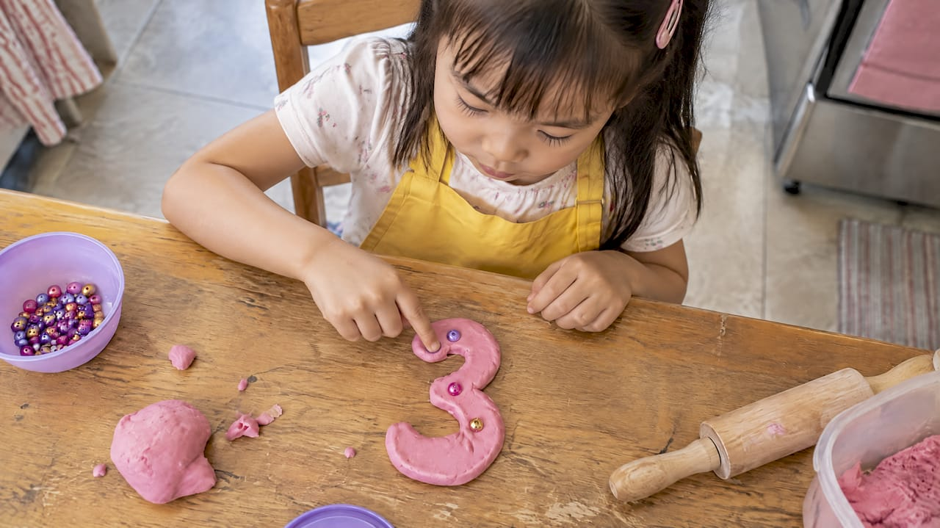
Playdough numerals. Roll playdough snakes and shape them into numerals, then press the matching number of small items, such as beads, into each one. Touching the shape helps many children remember it.
Peg and clothes-line matching. Cut cards showing a numeral on one side. Your child clips the matching number of pegs onto each card. This is also good for little fingers.
Everyday counting jobs. Early numeracy specialists suggest simple routines such as sorting laundry, comparing quantities at meals and counting steps. Ask your child to put three socks in each pile, or to tell you who has more grapes. Then show the numeral that matches.
Growing From a Few Numerals to 10 and Beyond
Resist the urge to show all the numbers at once. A gradual path keeps the experience positive:
Numerals 1 to 3. Use real objects only. Match, name and point.
Numerals 1 to 5. Add cards and dot pictures. Play bingo or hopscotch.
Numerals 1 to 10. Introduce ordering, the missing-number game and dice games.
Beyond 10. Add teen numbers slowly, linking them to groups of ten and ones when your child is ready.
It is useful to know what is expected as children approach Primary 1. The Nurturing Early Learners framework, updated in 2025, expects children to recognise numbers in both numerals and number words, and advises giving them chances to rote count to at least 20. MOE has also stated that for Primary 1 readiness, children need to be able to compare the quantity in two groups of objects within 10.
In other words, the bar is basic and friendly. Overpreparing can backfire: an early childhood specialist cautions that it can lead children to become bored and switch off. MOE likewise notes that tuition for kindergarten children may affect their curiosity, interest in learning and ability to focus in class. So keep the pace calm, and let your child’s interest lead.
Games Do More Than Teach Numerals
Play is not only a pleasant way in. MOE notes that games also support executive functioning skills, including inhibitory control, working memory and cognitive flexibility. Waiting for a turn, remembering where a matching card was, and switching between rules are all being practised while your child ‘just plays’.
If you would like more game ideas once numerals feel comfortable, our guide to mental maths games for kids and our piece on why your child should play maths games are good next steps.
Our Perspective: Recognition is the First Rung of a Bridge
At Mentalmatics, we work with pre-primary and primary children every day, and we see number recognition as the first plank in a bridge. On one side is a child who meets numbers with curiosity. On the other is a child who can calculate quickly and accurately, in their head, with confidence. Recognition is where that bridge begins.
That is why our programmes are built around songs, games, physical activities and interactive sessions, and why we move step by step from a physical abacus to mental arithmetic. A child who knows that 5 means five things can see five beads on the abacus, and later picture those beads without touching them. The picture in the mind grows from the object in the hand.
We also believe in self-paced learning. Some children recognise all the numerals to 10 within weeks, and others take months. Both are normal. What matters is that your child keeps trying, enjoys the process and feels proud of each small step. If you want to see how early numeracy connects with later skills, our article on strong numerical skills explains what children gain over time.
How to Tell Whether Your Child is Making Progress
You do not need worksheets or quizzes. Singapore’s early learning guidance says that assessing young children should happen through observation during games and daily activities, not through worksheets. So watch for these signs during play:
Your child points to the right numeral when you say it, first within 1 to 3, then 1 to 5.
They name a numeral you point to, even if it takes a moment.
They hand you the right number of objects when you show a numeral card.
They notice numbers on their own, such as ‘Look, a 2 on the bus!’
They can say which of two groups has more, within 10.
If your child seems stuck, go back one stage. Return to real objects, reduce the range of numbers, or try a different type of game. Mixed-up numerals such as 6 and 9 are very common at this age, and a playdough or sand-tracing version often helps.
For a wider view of what to expect before Primary 1, you may like our Kindergarten Mathematics Readiness Guide and how to prepare your kindergarten child for maths.
If Your Child Needs Extra Support
Every child learns at their own pace, and some need more time or a different approach. Shorter sessions, fewer numerals at once, more hands-on materials and plenty of repetition through songs and routines can all help. Praise effort, not speed.
If you are concerned about your child’s development more broadly, speak to your child’s preschool teacher or paediatrician. In Singapore, the Early Childhood Development Agency supports children with developmental needs through Development Support and Learning Support programmes in preschools, and its early intervention programme for the youngest children trains parents and caregivers to carry out strategies within daily home routines. Ask your preschool about what is currently available.
You can also extend learning from school: the agency encourages parents to take an active role, for example by using take-home numeracy kits from preschools.
When Your Child is Ready For More Structure
Once your child enjoys numerals and quantities, some families like to add a regular class that keeps the learning playful. Our Kindy Class is designed for pre-primary children, using songs, games and physical activities to introduce numbers and the abacus. Children then move on to Foundation, where they practise the four operations with our two-hand, four-finger abacus technique and progress towards mental arithmetic.

Not sure which level suits your child? Book a paid trial class and watch how your child responds. We will happily talk through what you see, and there is no pressure to rush. For ideas to try before then, our article on encouraging your young child’s interest in mathematics is a gentle place to start.
Frequently Asked Questions
At what age should my child recognise numbers?
There is no single age, because children develop at different speeds. Singapore’s early learning framework expects preschool children to work towards recognising numbers as numerals and number words, and the Primary 1 expectations are basic. Follow your child’s interest and speak to their preschool teacher if you have concerns.
Should I teach number recognition with worksheets?
Worksheets are not necessary at this age, and early numeracy guidance in Singapore favours play and daily experiences over drilling. Hands-on games, cards and real objects give your child a feel for quantity that a page of numerals cannot. A little tracing can be a pleasant extra, as long as it stays short and optional.
How long should each activity last?
Five to ten minutes is plenty for most preschoolers, and you can repeat the activity a few times a day. Stop while your child still wants more, so that the next session starts with enthusiasm. If attention fades quickly, switch to a more active game like hopscotch.
My child can count to 20 but cannot name numerals. Is that a problem?
It is very common, because counting by memory and recognising numerals are different skills. Bring in real objects, then matching cards, so that the symbol attaches to a quantity. Start with 1 to 3 and build up gradually.
Recommended
How Mentalmatics Can Help
At Mentalmatics, number recognition is understood as the very first step in a longer, purposeful journey. Once a child can link quantity, word and numeral confidently, the programme builds systematically from there – through structured abacus work that keeps numbers visible, movable and meaningful. Songs, games and hands-on bead activities extend the playful, multi-sensory learning this article recommends, while trained instructors ensure each new concept is secured before the next is introduced. The bridge from curious preschooler to confident, independent mathematical thinker is built one purposeful step at a time.
To find out more, talk to us or register for a trial class using the link below!


Comments